AI Demos and Portfolio
Bringing enterprise governance to AI-assisted software development
Independent Well Integrity Management System (WIMS)
Lumen — AI Business Intelligence Platform
Mortgage Freedom Tracker — Commercial Mobile Application
Senior Technology & Data Transformation AI Focused Consultant / Analyst
This portfolio demonstrates practical applications of AI in real-world operational contexts that I designed, with emphasis on solution design, workflow integration, and business value delivery, leveraging modern AI platforms and cloud ecosystems (e.g. Amazon Bedrock on Web Services, Microsoft Azure AI, Google Vertex AI).
- Led end-to-end current-state assessment of Well Integrity Management System (WIMS) across the full well lifecycle, identifying systemic gaps in data governance, workflow design, and regulatory assurance within a safety-critical environment.
- Engaged cross-functional stakeholders (Production Engineering, Asset Services, Technical Authority, Field Operations) to map and validate integrity workflows, uncovering heavy reliance on manual processes, fragmented data sources, and low system trust.
- Identified critical limitations in existing WIMS implementation, including inability to support automated risk classification (traffic light model), lack of auditability, and absence of real-time integrity monitoring across thousands of wells.
- Designed a target-state AI-enabled Well Integrity Monitoring & Assessment solution, leveraging machine learning–based anomaly detection and time-series analysis to identify early indicators of well integrity risk.
- Defined architecture incorporating AI agents, LLM-assisted workflows, and retrieval-augmented data access (RAG) to dynamically generate context-aware assessments, automate data ingestion and validation, and orchestrate workflows across engineering teams.
- Introduced concept of agent-based workflow orchestration, enabling automated task routing, natural language explanations of anomalies, and intelligent prepopulation of integrity assessments—reducing manual effort and improving decision consistency.
- Highlighted integration strategy across enterprise systems (SAP, MDM, Nexus, OCIS) using API-led architecture to enable unified data access and support AI-driven analytics and regulatory workflows.
- Reframed WIMS program from a system upgrade to an enterprise-wide integrity management transformation, positioning AI as a key enabler for proactive risk management, predictive analytics, and scalable compliance.
- Developed comprehensive business and regulatory requirements covering workflow automation, integrity assessment, failure management, and advanced analytics, forming the basis for future-state platform evaluation and solution design.
- Delivered actionable insights to senior stakeholders, influencing strategic direction toward AI-enabled decision support, improved auditability, and data-driven integrity assurance.
USE CASE 1: AI-ENABLED WELL INTEGRITY RISK MONITORING
Problem
The Well Integrity Management System relied on fragmented and inconsistent data sources, resulting in:
MASP and pressure data distributed across multiple systems
- Data inconsistencies, latency, and misalignment
- Heavy reliance on manual interpretation by engineers
- Missed early warning signals and leading indicators
- Disjointed, manual workflows across stakeholders
Additionally:
Well Integrity Assessments were conducted using static, spreadsheet-based forms, often including irrelevant fields
- Assessment results required manual analysis, increasing time, effort, and risk of human error
- Risk calculations (current and future) were manually derived
- Follow-on workflows (regulatory, remediation, close-out) were manually triggered and managed
The AI-Enabled Solution
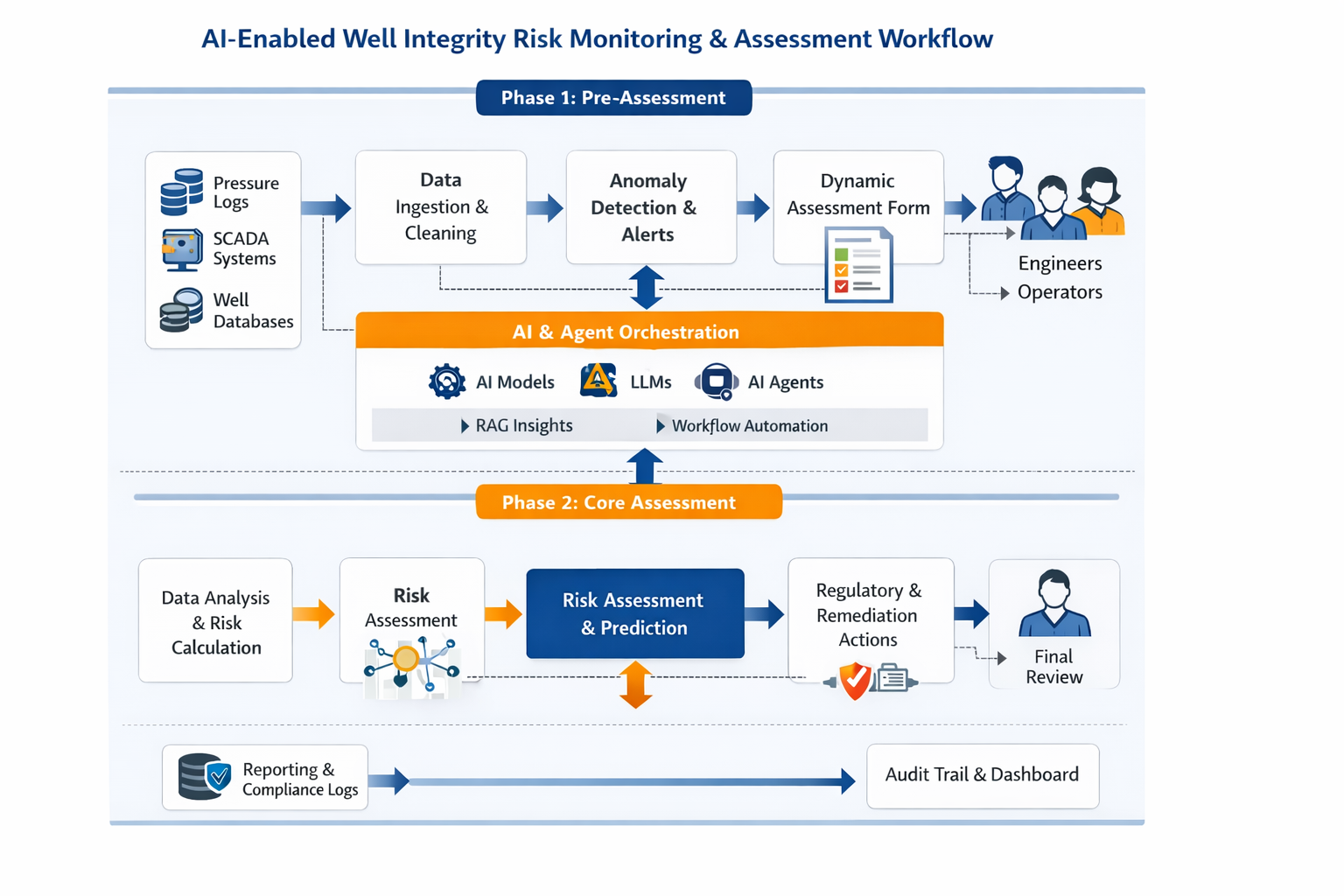
Designed an AI-assisted and agent-driven Well Integrity workflow that enhanced pre-assessment, assessment, and post-assessment processes through automation, intelligent analysis, and dynamic workflow orchestration.
The solution integrated:
- AI-driven data conditioning and anomaly detection
- Agent-based workflow orchestration
- Dynamic digital assessment forms
- AI-assisted risk modelling and decision support
Solution Architecture Overview
The solution was structured across two core phases:
Phase 1: AI-Driven Pre-Assessment & Early Risk Detection
Workflow Design
- Ingest pressure and well data from multiple logs, databases, and operational systems via APIs
- AI layer performs:
- Data segregation to isolate relevant datasets (e.g. filtering non-relevant scouting log data)
- Data quality validation and cleansing based on defined rules and patterns
- Apply AI/ML models and LLM-assisted logic to:
- Detect early anomalies and leading indicators
- Identify deviations from expected operational patterns
- AI generates:
- Natural language explanations of anomalies
- Contextual insights using historical data (RAG pattern)
Agent-Based Orchestration
AI agents coordinate:
- Routing anomalies to the appropriate well / reservoir / production engineer based on issue type
- Triggering alerts and initiating workflows
- Assigning tasks to operators and engineers for additional data collection
- Tracking actions and maintaining audit logs
Dynamic Assessment Preparation
- Generate a context-aware digital Well Integrity Assessment form:
- dynamically tailored to the identified anomaly
- irrelevant fields and sections removed
- Prepopulate form fields with:
- cleansed data
- AI-derived insights
- contextual historical information
Business Outcome (Phase 1)
- Early detection of integrity risks
- Reduced manual data preparation
- Improved workflow coordination across stakeholders
- Faster initiation of assessment processes
Phase 2: AI-Assisted Core Well Integrity Assessment
Workflow Design
- Ingest results from pre-assessment workflows (field inputs, engineer feedback, operational data)
- AI layer performs:
- Natural language analysis of submitted data and observations
- Anomaly detection across combined datasets
- Pattern recognition across historical and current data
AI - Driven Risk Assessment
- Generate:
- Risk scoring and classification / updating traffic light system
- Time-series based failure predictions (e.g. estimated time to integrity failure)
- Identification of contributing factors and risk drivers
Agent-Enabled Decision Support & Workflow Execution
AI agents:
- Populate and refine the digital Well Integrity Assessment
- Provide AI-generated recommendations and insights
- Trigger:
- remediation workflows
- regulatory compliance processes
- reporting and audit requirements
- Enable human-in-the-loop validation by engineers prior to finalisation
Business Outcome (Phase 2)
- Reduced assessment time and effort
- Improved accuracy and consistency of risk evaluation
- Proactive identification of future integrity risks
- Streamlined regulatory and remediation workflows
Concepts, capabilities and technologies demonstrated
Indicative Technologies / Concepts
- LLM platforms
- AI agents for workflow orchestra
- AI agents for workflow orchestration and task management
- Retrieval-Augmented Generation (RAG) for contextual insights
- Time-series anomaly detection models
- API-based integration with engineering systems (e.g. WellView Well Management)
- Vector databases for semantic search and historical analysis
- Model Context Protocol (MCP) concepts for controlled data and tool access
Key Capabilities Demonstrated
- End-to-end AI-enabled workflow design (pre-assessment → assessment → remediation)
- Integration of AI into existing engineering and data systems
- Dynamic, context-aware user interface design (adaptive assessment forms)
- Application of AI to risk modelling and decision support in high-consequence environments
Agent-based orchestration of complex operational processes
Workflow Design
- Aggregate pressure and well data from multiple systems
- AI/agent layer:
- detects anomalies in time-series data
- retrieves historical context via APIs
- generates natural language explanations using LLMs
- Agent orchestrates:
- alert generation
- routing to engineers
- follow-up actions
- Human-in-the-loop validation and decision logging
Indicative Technologies / Concepts Used
- LLM platforms
- AI agents for workflow orchestration and alerting
- Time-series anomaly detection
- API integration with engineering systems
- Model Context Protocol (MCP) concepts for controlled data/tool access
Business Value Achieved
- Earlier identification of integrity risks
- Reduced manual analysis effort
- Improved decision-making speed and consistency
Key Considerations Demonstrated
- Data quality and consistency
- False positives and alert fatigue
- Requirement for human validation